

On Wednesday, November 11, 2026, the SS United States went to the bottom of the Gulf of Mexico about 20 nautical miles off the Florida coast, between Destin–Fort Walton Beach and Pensacola. Okaloosa County bought the liner in 2024 to turn her into the world's largest artificial reef. Before she was towed out, the county spent a year in Mobile, Alabama, removing what it called "environmentally unsafe materials" in coordination with the EPA and Florida's Department of Environmental Protection (CBS News).
The news stories recalled her speed record, which still stands. Our library holds the other side of her story: what she was built from. In 1952 the asbestos industry's trade journal described her as "the safest and most comfortable ship afloat." The reason it gave was asbestos.
"Used exclusively for all of the accommodations"
The June 1952 issue of Asbestos, the industry's monthly magazine, ran a feature headed "Half Million Square Feet of Marinite for the S. S. United States" (ACL Doc 12440, pp. 12–16). Marinite was Johns-Manville's fireproof board for ships. The magazine called it "a rigid sheet material made of asbestos fibre combined with an inorganic binder," and said:
These asbestos materials are used exclusively for all of the accommodations including crew quarters as well as passenger areas. More than a half million square feet were installed.
According to the article:
- It was the largest single marine installation of Marinite at that point. By 1952, more than thirty million square feet had gone into ships of every kind.
- No wood was allowed. "On the S. S. United States no wood or other combustible veneers were allowed." Most panels were faced at the J-M factory with thin sheet metal and painted after they were put up.
- She got a lighter grade. Standard marine Marinite weighed 36 pounds per cubic foot. For this ship, J-M's research men made "a Marinite of still less weight." A 1967 J-M employee magazine called it "special lightweight Marinite-30 faced with aluminum" and said it protected "all the bulkheads" (J-M News Pictorial, September 1967, ACL Doc 12855).
- Workers cut it on the job. Most sheets came factory-cut to size, "however, some on-the-job cutting was inevitable." The panels "can be cut and shaped as readily as wood" and "sawed and drilled using conventional types of hand or power tools."
The article also explained why the ship was built this way. In 1934 the liner Morro Castle burned off the New Jersey coast. Committees then rewrote the safety rules for ships at sea. One early step was to strip an old vessel and use it as a floating fire-test laboratory, where test rooms built from different makers' materials were burned with cordwood. Marinite passed. Its first ship was a small island steamer rebuilt in 1936 to plans by the naval architects Gibbs & Cox, "probably the world's first complete fireproof passenger craft." As the magazine noted, the same firm later designed the SS United States.
What Marinite was made of
Johns-Manville made a promotional film, Safer Ships for Our Merchant Marine (ACL Doc 21525). It names the raw materials as "asbestos fibers, diatomaceous silica, and lime." It ends with the United States, the "latest glamour girl of the United States Lines," and repeats the half-million-square-foot figure. It also says J-M supplied "a special type of Marinite of even less density" for her, which helped give her "unprecedented speed."
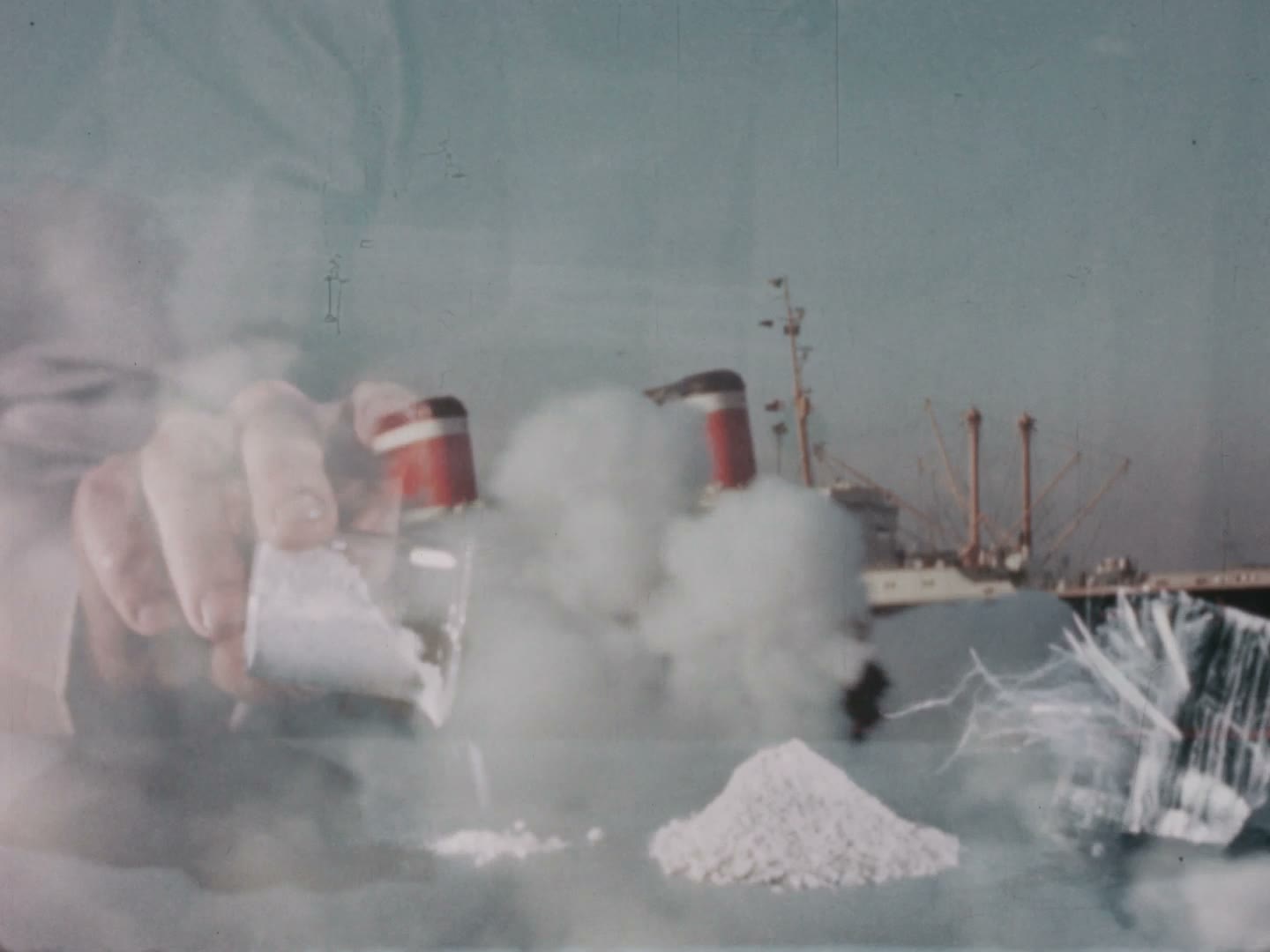
Johns-Manville's own film. Starting here, the narrator spends about 50 seconds on the SS United States. He calls her "probably the fastest transatlantic liner ever built" and credits her more than half a million square feet of Marinite. He never mentions that the board was asbestos, or what breathing its dust could do to the men who cut it.
Watch the whole film, with its transcript: Safer Ships for Our Merchant Marine
The type of asbestos matters. J-M's own corporate history says the company first made Marinite in 1936. It met the marine weight limit by switching from Canadian chrysotile to amosite, a South African amphibole (see our Marinite page). Amphiboles cause mesothelioma at much lower doses than chrysotile does. J-M's 1978 safety data sheet for Marinite 36 lists "Amosite Asbestos Fiber" at 30 percent (ACL Doc 24069). In 1968 J-M's environmental control department wrote that the Marinite grades "contain chrysotile and amosite asbestos fibre" (ACL Doc 11160).
We have not found a specification sheet for the exact grade used on the United States. But J-M's records show that amosite was how Marinite was made light, and her panels were lighter than standard.
Marinite was not the only J-M asbestos product on board. A 1961 J-M employee magazine called her "the pride of the nation's luxury liners" and listed Marinite "exclusively for all accommodations" (ACL Doc 12798). The same page describes J-M's Marine Veneer as "made of asbestos fibre and cement." It also describes Reeferite, which had two faces of that veneer over an aluminum core and was used in cold-storage areas. In 1963, J-M brought eleven of its women employees on board for a fashion shoot. The caption says the liner "was built with J-M products, including Marinite (a classic ocean-going product), Reeferite, and BX-Spintex" (ACL Doc 12818). BX-Spintex was mineral wool, not asbestos.
A sales tool for J-M
J-M used the ship to sell Marinite for years. In January 1954, Asbestos reported that the managing director of Britain's Cape Asbestos Company sailed to New York on the United States. On board, he inspected "the Marinite panelling supplied by the Johns-Manville Corporation." Cape and J-M had formed a joint company, Marinite Ltd., in 1952 to sell the board to European shipbuilders. He was "particularly interested in this 'all-Marinite' ship" (ACL Doc 12459).
Johns-Manville's film shows how the boards were worked in the shipyard. The footage was shot at Bethlehem Steel's Quincy yard while two other liners, the Independence and the Constitution, were being built. Workers cut the panels with a saw "fitted with a silicon carbide cutting wheel," beveled the edges with a high-speed router, and drilled screw holes through them by hand. The narrator says a dust disposal system "is desirable when volume cutting is to be done." He never says the dust is asbestos, or that it could be harmful.
What Johns-Manville knew about Marinite dust
In June 1958, a J-M man named V. B. Padham reported on Marinite dust at the Newport News Shipbuilding yard. That is the Virginia yard that built the United States. His letter is not in the file, but the replies to it are (ACL Docs 11634–11643):
- T. H. Eaton at J-M's division headquarters wrote that it involved "a situation in which J-M may in the future have some responsibility." He also wrote about "the potential hazard in confined quarters."
- Herbert Ball, J-M's general attorney, wrote that the Newport News situation "may result in extensive legal liability" unless it was "properly handled." He added that "placing a statement in the literature does not carry to the employee the information he should have," and urged a label on the back of every sheet.
- J-M's medical director, Dr. Kenneth Smith, drafted a label: "Inhalation of dust produced in sawing, drilling or trimming this board may be harmful. Avoid breathing this dust."
- W. G. Hoffer of the sales division argued against it: "a caution label on our products - and none on theirs would make our selling efforts most difficult." J-M chose to add one sentence to a fabricating instruction booklet instead. No label went on the board.
Ten years later, in 1968, J-M again discussed a Marinite label. A sales manager asked for a small label "for use on the edges only," reading: "Contains asbestos fiber which may or may not be hazardous to your health when inhaled." He wrote that the largest user of Marinite in the marine industry did not want a label at all. That customer agreed to one on the edge if J-M would "make it as small as possible" (ACL Doc 11781).
By late 1970 the sheets carried labels. That December, Hopeman Brothers, a marine customer, said its workers were spending about ten minutes per sheet scraping and sanding the labels off. It threatened to cancel its orders unless the labels stopped. J-M's lawyers approved stamping the same caution wording on the sheets in red ink instead (ACL Doc 11780).
That was 18 years after the United States was finished. The shipyard joiners and carpenters who cut and fitted her half million square feet of board in 1950–52 never saw a warning on any of it.
Who was exposed
The workers most exposed were the people who built her. Joiners, carpenters, shipfitters, and the trades working near them at Newport News sawed, drilled, and fitted the panels in her cabins and passageways. Then came the crews who sailed her from 1952 until she was taken out of service in 1969, and the yard workers who maintained and repaired her. Last came the workers who stripped the asbestos out of her decades later. Her furnishings were auctioned in 1984, and the asbestos was removed in Turkey and Ukraine in the early 1990s.
Seamen on asbestos-insulated ships breathed it at sea, too. In 1980, NIOSH told a House subcommittee about fiber counts measured in the engine rooms of merchant ships, and said ripout work at a naval shipyard had produced levels of 40 to 150 fibers per cubic centimeter (ACL Doc 21608). Today's federal workplace limit is 0.1 fibers/cc.
Her operator, United States Lines, filed for bankruptcy in 1986. A trust set up in its reorganization handles claims for asbestos and other injuries brought against the company. Deadlines in that bankruptcy have been strict. In a 2006 ruling, a federal court upheld the dismissal of claims by three merchant mariners who had sailed on U.S. Lines ships. Each claim had been filed more than 180 days after the injury "manifested" (In re United States Lines, 2006).
Our take
What this means if you have, or may have, an asbestos claim
The SS United States was built so no passenger would die in a fire like the Morro Castle's, and Johns-Manville met that goal with asbestos. By 1958 its own files called Marinite dust at her shipyard a legal and health problem, yet it chose not to label the board because a warning would hurt sales.
If you or a family member built, sailed on or repaired the United States, or any ship lined with Marinite, and now have mesothelioma, asbestos lung cancer or asbestosis, you may have a claim, including with the Manville trust. Our shipyard and maritime page explains who was exposed and how.
Read something that sounds familiar? Free case review. No records or product names needed, and no fee unless we recover compensation for your family.
Sources
- "Half Million Square Feet of Marinite for the S. S. United States," Asbestos, June 1952, pp. 12–16 (ACL Doc 12440); summarized in Manville's 1986 Asbestos Magazine Summary, 1919–1953 (ACL Doc 10009).
- Johns-Manville, Safer Ships for Our Merchant Marine, film, c. 1950s (ACL Doc 21525).
- "Giles Newton Visits United States and Canada," Asbestos, January 1954, p. 47 (ACL Doc 12459).
- J-M News Pictorial, March 1961, p. 11 (ACL Doc 12798); May 1963, p. 3 (ACL Doc 12818); September 1967 (ACL Doc 12855).
- Johns-Manville Memos on a Caution Label for Marinite (1958).
- C. L. Sheckler to D. B. Wingerter on Caution Labels for Sil-O-Cel and Marinite Insulation Products (1968).
- P. F. Coggins to R. H. North on a Small Caution Label for Marine Marinite (1968).
- P. F. Coggins Telex on Hopeman Brothers and the Marinite Caution Labels (1970).
- Johns-Manville Material Safety Data Sheet for MARINITE #36 (1978).
- Statement of Richard A. Lemen (NIOSH) to the House Subcommittee on Coast Guard and Navigation, February 12, 1980.
- In the Matter of United States Lines Inc. (S.D.N.Y. 2006).
- SS United States Conservancy, History: Retirement.
- Maritime Reporter, "S.S. United States To Auction Contents Prior To Total Renovation" (September 1984).
- Skyler Henry and Faris Tanyos, "SS United States sinks off Florida's Gulf Coast," CBS News, November 11, 2026.
This post is news and commentary, provided for general information. It is not legal advice and does not create an attorney-client relationship.